Wednesday, April 27, 2016

Sheep Eye Disection

 In this picture, you can see the eyelid, cornea, sclera, and lots of fatty tissue!
 If you look closely, the optic nerve is visible

 The retina detached when we cut open the sclera but it is still slightly visible. The white ball is the lens and the black and blue fluid is the choroid.


 This is the vitreous humor and when we removed this, we saw the lens. The pupil was transparent and the iris was visible.

 lots of fatty tissue!


Thursday, April 14, 2016

Clay Brain

In this lab, we made a clay model of the brain. We did the anterior of the right hemisphere of the brain and the inside of the left hemisphere. We used different colors and tabs to identify the different structures. 

Wednesday, April 13, 2016

The Woman with a hole in her brain

I found this article interesting because i have never heard of anything like this before. It is so fascinating that it took her 24 years to find out that she was missing part of her brain. To have your cerebellum missing and still going through life like normal is absolutely insane. The cerebellum plays such a large part in the way you move and talk that it is almost unbelievable to live without one. I learned that the brain is a very complex structure that can interest anyone very easily.
The corpus callosum is a bundle of nerve tissue that connects the left and right hemisphere. This allows different parts of the brain to communicate with each other. It is possible to survive without this tissue. As a matter of fact, some people are born with a defect that include a lack of this tissue. By disrupting the contact between the right and left hemispheres, a seizure can be isolated and caught from spreading.

Tuesday, March 29, 2016

Unit 7 Reflection

In this unit, we learned about all of the muscles in our body. We first learned different terms and joint movements. These were interesting and a little easy for me to remember because i learned all of these terms last year when i took Sports Medicine. Next we learned about the muscular system. We learned that there are many properties of muscle tissues. An example of one is excitability which was the ability to receive and respond to stimuli. We also learned about the different classification of muscles and how to distinguish which muscles are which. Something that i struggled a lot with was labeling the muscles on the body. There were so many of them that sounded alike so it was a little bit confusing. One of the last things we did in this unit was learn about different performance enhancements. This was my favorite thing that we learned in this unit because it was cool to see the effects that different enhancements had on your body. For example, I learned that caffeine has many risks to it which is bad for me because i drink it almost everyday. Caffeine can cause cramping, dehydration, and can suppress your appetite. Now that I know this, I will try to drink it less often. Some labs and activities we did in this unit was the chicken muscle dissection and the performance enhancement advertisement. The chicken dissection was really fun but a little confusing because it was hard to identify all the muscles. The advertisement was fun because i enjoyed the lecture and it was cool to learn about what anabolic steroids can do to you. I learned from this activity that for males, it can cause reduced sperm count and it can stop their growth. For females, this can cause male like facial hair and also stop. 


Wednesday, March 23, 2016

Anabolic Steroids Slide

In this lesson we learned about different performance enhancements and how some of them are actually very unhealthy for you. An example of one performance enhancement is anabolic steroid which is the one I did for my advertisement. I learned that this enhancement is used to mainly increase your muscle mass. There are multiple negative affect to it which differ for both men and women. For men, this can lead to infertility, breast development, shrinking of testicles, and reduced sperm count. As for women, this can lead to male type body hair, breast shrinkage, deepening of voice, and problems with women menstrual cycle.

Monday, March 21, 2016

Chicken Dissection Analysis

pectoralis major

pectoralis minor

trapezius

latissimus dorsi

deltoid

biceps brachii

triceps humerals

flexor carpi ulnaris

brachioradialis

satorius

tensor fasciae latae

biceps femoris

semimembranosus

semitendinosus

quadriceps femoris

gastrocnemius

peroneus longus

tibialis anterior

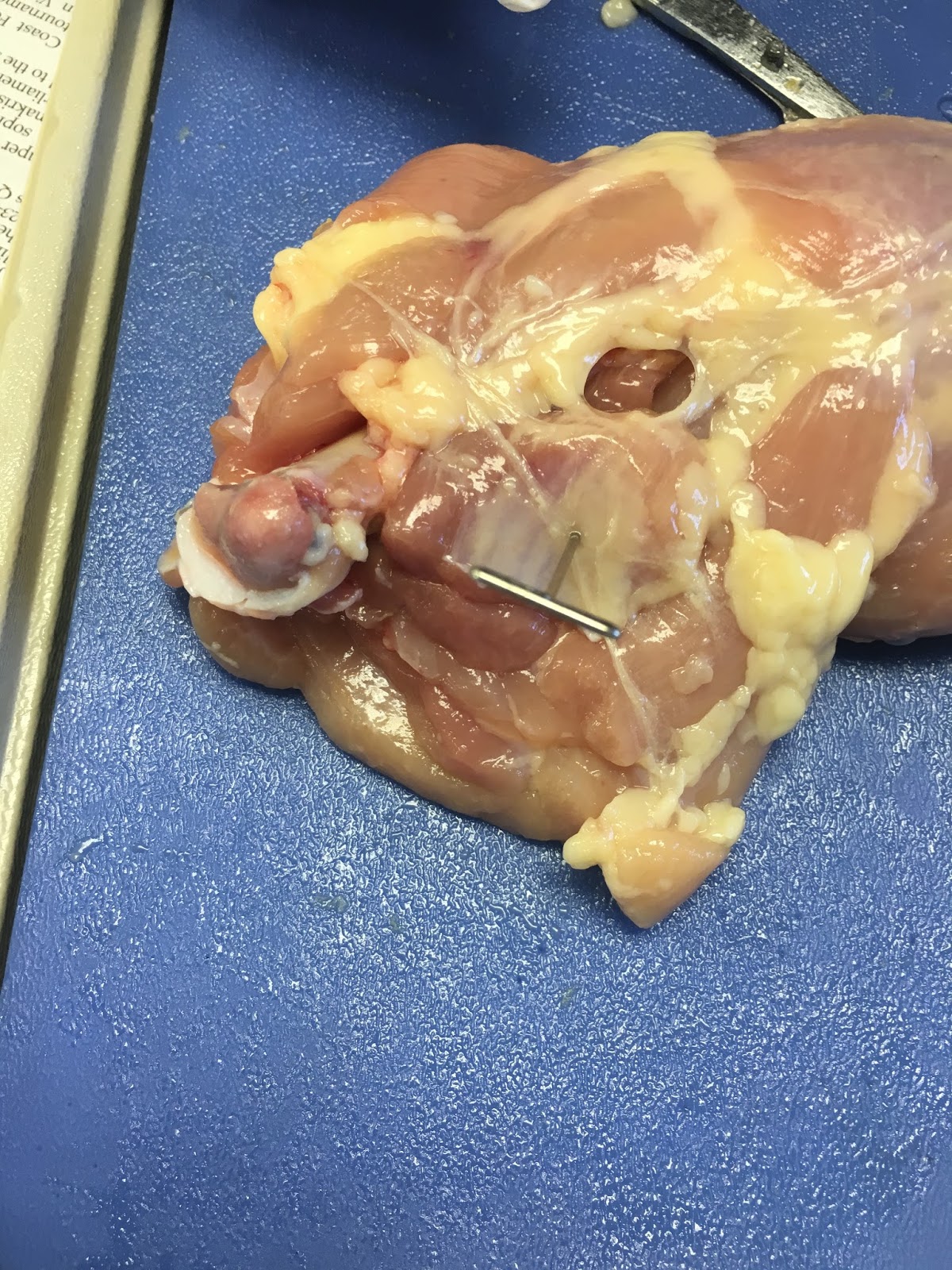
In this lab, we dissected a raw chicken and tried to look for all of its muscles and identified them. The muscles, tendons and bones allow the chicken to move in different way. When we cut the skin of the chicken, we found the pectorals major and then the minor. These are ht muscles on the breast that help the chicken stand upright. The trapezius and lattisimus doors were both on the back of the chicken. These allow the shoulders to move around. When we removed a chicken wing, we found the brachioradialis and the flexor carpi ulnas. These allow the arms to move and retract. Then, we looked at the chicken thigh. We found the satorius, the biceps femoris, and the semimembranosus. These allow the legs to move and allow the chicken to walk. Then we removed the skin from the drumstick of the drumstick. We found the gastrocnemius, peroneous longus and tibialis anterior. They allow the leg to bend and flex and maintain the balance the chicken needs. On the thigh, we also found the quadriceps femoris, and medialis which allows the leg to also flex and bend. In the end, the lab was actually very fun and interesting to learn.